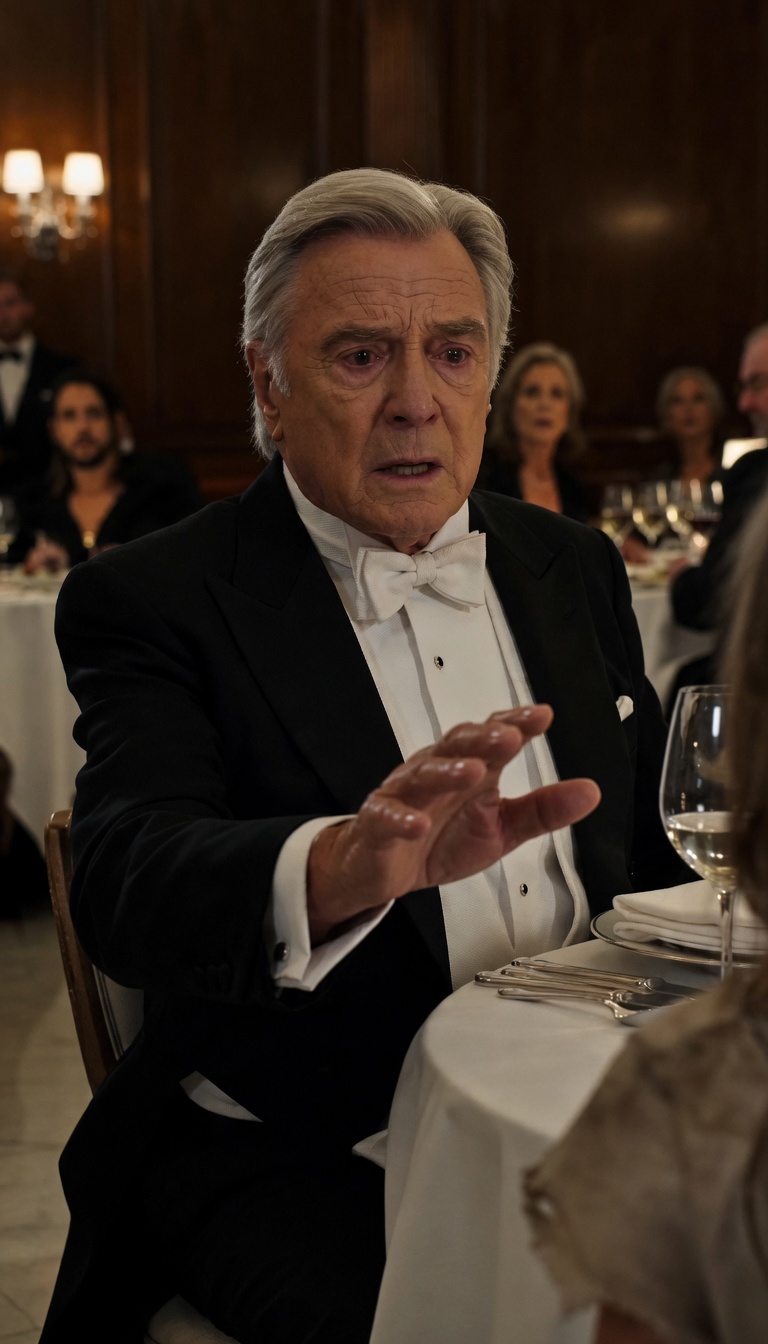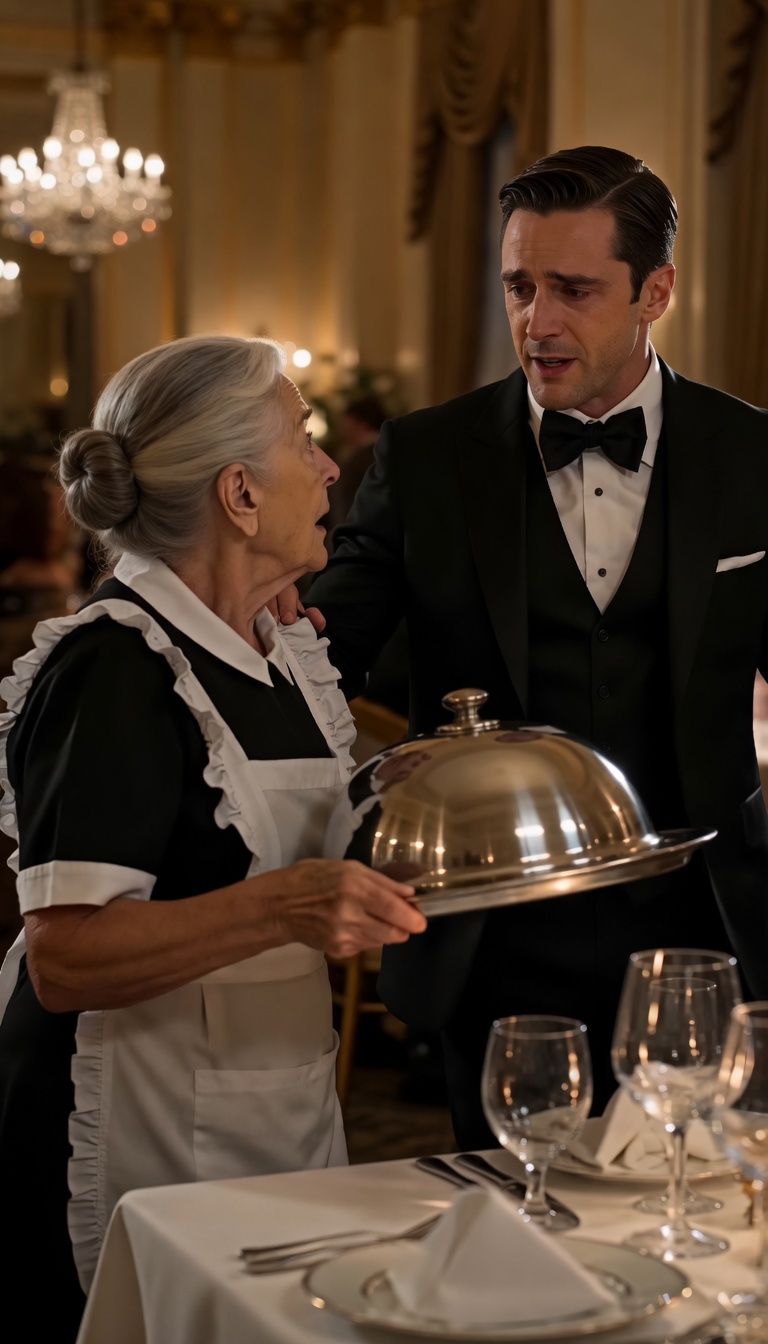
The lights of the Grand Elysium chandelier sparkled like frozen stars, casting a warm, golden glow over the dining room. To the patrons, it was just another night of fine dining, but to Elena, it was the final night of a forty-year career. Her feet, swollen and weary, moved across the polished marble with a rhythm born of habit. She was sixty-five, a woman whose face was a roadmap of quiet struggles and silent sacrifices. She was the one who cleared the tables, the one who stayed late, and the one who had seen thousands of people come and go, yet remained invisible to most.
At table seven, a man sat alone. He was in his early thirties, dressed in a bespoke midnight-blue suit that commanded attention. He hadn’t touched his meal. Instead, his eyes, dark and intense, followed Elena as she navigated the crowded room. There was a haunting familiarity in his gaze, a weight that seemed to press against the glass of the room’s air-conditioned stillness.
Elena approached the table to collect the water carafe. “Would you like anything else, sir?” she asked, her voice raspy with the fatigue of a double shift.
The man didn’t look at the bill. He stood up slowly, and as he turned, Elena felt a sudden, inexplicable shiver. It wasn’t the cold; it was the way he looked at her—not as a servant, but as someone who held the pieces of his very soul.
“Do you remember the winter of 2006, Elena?” he asked softly.
The name, spoken by a stranger, struck her like a physical blow. She paused, her grip tightening on the tray. “Sir, I… I serve many people. I’m afraid I don’t recall—”
“It was snowing,” he interrupted, his voice dropping to a whisper that cut through the background chatter of the restaurant. “The soup kitchen on 4th Street. You were a volunteer. I was a boy—dirty, starving, and hiding from a world that had forgotten me. You gave me your own coat because I was shivering, and you brought me soup every night for a week until I found my feet. You told me that no matter how dark it gets, there is always a dawn.”
The air in the room seemed to vanish. Elena’s eyes widened. She stared at him, searching for the boy beneath the sharp jawline and the commanding presence. Slowly, the image of a terrified child began to merge with the man standing before her. She remembered the boy. She remembered the way his hands shook, and the way he had looked at the world with such deep, profound distrust.
“Julian?” she breathed, the name barely audible.
The man’s eyes glistened. He reached out, his hands trembling—hands that had likely signed billion-dollar contracts, yet now moved with the vulnerability of a lost child. “I have been searching for you for ten years, Elena. I built everything I have with the memory of that soup and that coat. You were the only one who didn’t look at me with disgust.”
He reached into his breast pocket and pulled out a heavy, velvet-lined box. With a trembling hand, he placed it on the table. He took her worn, calloused hand—a hand marked by years of scrubbing, lifting, and serving—and placed a set of keys into her palm.
“I have purchased the house where you grew up,” he said, his voice thick with emotion. “And I have ensured that you will never have to work a night shift again. You saved a boy who had nothing. Today, that boy wants you to have everything.”
The silence in the Grand Elysium was absolute. The other guests, who had spent their evening caught up in their own self-importance, now stood frozen. The mask of social status had been shattered. In the center of the room, the woman in the maid’s apron and the titan of industry were locked in an embrace that defied the boundaries of class, money, and time.
Elena wept, not out of sadness, but out of a sudden, overwhelming release. For decades, she had felt like a ghost in her own life, working to keep others comfortable while she quietly faded away. Julian’s act of gratitude hadn’t just given her financial freedom; it had given her back her dignity. It reminded her that the small acts of kindness she performed in the shadows were not wasted—they were ripples that eventually returned to her as a wave of love.
As they walked out of the restaurant together, leaving behind the hollow glitter of the dining room, the world outside was bright. The city air felt crisp and full of promise. Julian held the door open for her, not as a wealthy benefactor, but as a son reclaiming his mother.
That night, the Grand Elysium continued its business, but the memory of the encounter lingered. It was a stark, beautiful reminder that success is not measured by the numbers in a bank account, but by the lives we touch and the memories we choose to hold dear. True kindness is a currency that never loses its value; it only accumulates interest in the hearts of those who receive it. And for Elena, the woman who had once stood in the cold to feed a stranger, the dawn had finally arrived.