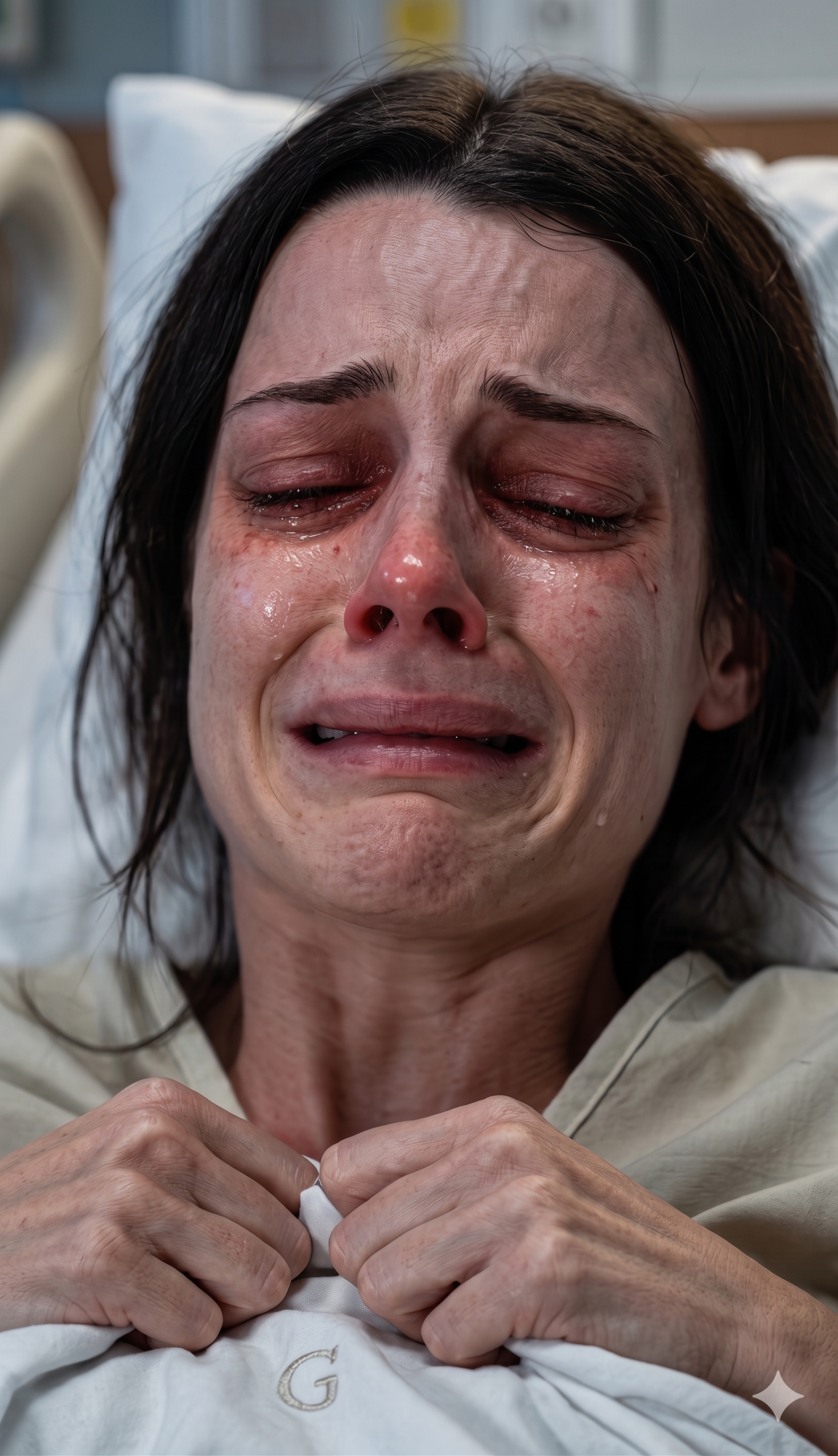
The fluorescent lights of the hospital room hummed with an irritating, clinical buzz. Elias stood by the bassinet, his shadow stretching long and jagged against the sterile white wall. Inside the plastic crib lay a tiny, fragile creature—his son. Or at least, that was what the birth certificate claimed.
Elias stared at the infant with eyes cold enough to freeze the room. He didn’t see a miracle; he saw a calculated deception. For the past six months, he had been plagued by whispers and anonymous messages, seeds of doubt planted by someone who claimed his wife, Clara, had been unfaithful during a business trip to London. Looking at the baby—whose features, he convinced himself, lacked his own sharp jawline—Elias felt his heart turning into a stone.
Clara, pale and exhausted from the labor, watched him from the hospital bed. “Elias, please,” she whispered, her voice trembling. “Why are you looking at him like that? Like he’s a stranger?”
“Is he, Clara?” Elias snapped, not turning around. “You spent two weeks in London. You came back different. And now, I’m looking at this child, and I don’t see myself. I see a lie.”
Clara burst into tears, her body racking with sobs that seemed to bruise her already fragile state. “How can you say that? How can you look at your own flesh and blood and doubt me? I have been nothing but loyal to you!”
The tension in the room was suffocating. Elias felt trapped in a narrative of betrayal he had written himself. He was ready to walk out, to leave his life behind, to embrace the bitterness that had been festering in his chest.
Just then, the door creaked open. Dr. Aris, a seasoned physician with a face etched by years of delivering both joy and sorrow, entered the room. He held a manila folder, his expression uncharacteristically grave.
“Mr. Thorne,” the doctor said, his voice steady. “I have the results of the urgent blood work and the genetic screening we requested following the complications during the birth. We needed to ensure there were no underlying hereditary issues that caused the respiratory distress he experienced.”
Elias turned, his jaw clenched. “Just tell me. Is there something wrong with the baby?”
“There is something unique about him,” the doctor replied, opening the file. He handed a document to Elias. “When we ran the standard compatibility tests, we encountered an anomaly. It wasn’t that the baby didn’t match you, Mr. Thorne. It was that he matched you in a way we rarely see.”
Elias frowned, scanning the technical jargon. “What are you talking about?”
“It’s a rare condition, a genetic marker that hasn’t surfaced in your family for three generations,” Dr. Aris explained, pointing to a highlighted section. “The reason you felt he didn’t look like you is that he carries a recessive trait that was thought to be dormant in your lineage. Furthermore, there was a mix-up in the nursery records earlier today—a nurse had accidentally tagged a different baby’s file with your son’s name for a moment. You were likely looking at the wrong paperwork for an hour.”
Dr. Aris sighed, looking at them both with kindness. “Your son is 100% yours. And Clara? Your wife’s medical history from the last few months, which she insisted we review, shows she has been under significant stress—but the biological markers confirm the child is yours, without a shadow of a doubt. The ‘stranger’ you were looking at was, in fact, the most perfect reflection of yourself.”
The silence that followed was absolute. Elias felt the floor tilt beneath him. The accusation that had built a fortress around his heart crumbled in an instant. He looked at the file, then at Clara, whose face was a mask of hurt and relief, and finally at the baby. He walked back to the bassinet. As he leaned in, the baby opened his eyes—a deep, familiar hazel—and reached out a tiny hand to grasp Elias’s thumb.
The realization hit him like a physical blow. He had been so blinded by his own insecurity that he had nearly thrown away the only thing that mattered.
“Clara,” he choked out, dropping to his knees beside her bed. He took her hand, covering it with kisses. “I am so sorry. I was a fool. I let shadows dictate my reality.”
Clara looked at him, her eyes still wet but softened by the truth. “I was terrified, Elias. I thought I had lost the man I married.”
“You haven’t,” he whispered. “You’ve only found the man who will spend the rest of his life making it up to you.”
The room no longer felt clinical. The harsh lights seemed to dim, replaced by the soft, golden warmth of a new beginning. They sat together—a family of three, finally whole—as the sun began to rise over the horizon, washing away the darkness of the night and the bitterness of the doubt.